
OptiSafe EIT™
The only nonanimal eye irritation test with 100% sensitivity for nonirritants. Shelf-stable, vegan, OECD TG 496 accepted. Results in under 24 hours.
100%
Sensitivity for nonirritants
>90%
Overall accuracy
<24 h
Time to results
None
Animal ingredients
How OptiSafe EIT™ works
The OptiSafe EIT™ is an in chemico nonanimal eye irritation test that identifies ocular nonirritants with 100% sensitivity; the highest of any new alternative method (NAM) currently available. It uses a shelf-stable, vegan macromolecular test matrix that mimics the biochemical environment of the anterior segment of the eye.
The method is based on the principle that ocular irritants must pass through the tear film to interact with and disrupt the macromolecular components of the cornea. When a test material is added to the OptiSafe matrix, irritants cause a measurable change in optical density that correlates with their irritation potential. Nonirritants produce no significant change.
Unlike cell-based methods such as EpiOcular or SkinEthic RHC, OptiSafe requires no aseptic technique, no live tissue, and no specialized cell culture equipment. A standard laboratory spectrophotometer is all that is needed beyond the kit contents. This makes OptiSafe accessible to any analytical chemistry laboratory — not just those with cell culture infrastructure.
OptiSafe is suitable for cosmetics, personal care products, industrial chemicals, pharmaceuticals, and agrochemicals. It is accepted under OECD Test Guideline 496 for GHS Not Classified (NC) determination, and is recognized by regulatory agencies in the EU, US, Canada, and internationally.
OECD Test Guideline 496
OptiSafe Procedure
Run Pretest Kit
Measure solubility, buffering, and foaming to select the right assay.
Run OptiSafe Test
No aseptic technique. Standard lab bench setup.
Incubate
Overnight (18 hour) incubation with the OptiSafe matrix.
Measure
Read absorbance on spectrophotometer.
Classify
Apply decision criteria and classify as nonirritant or irritant.
Application domains
Cosmetics & Personal Care
Shampoos, conditioners, cleansers, makeup
Industrial Chemicals
Solvents, cleaning agents, process chemicals
Pharmaceuticals
Ophthalmic excipients, topical formulations
Agrochemicals
Pesticides, herbicides, formulation ingredients
What is outside of the OptiSafe application domain?
Metal Oxides
Many sunscreens and eye shadows contain high levels of metal oxides and are outside the OptiSafe application domain.
What do I do if my formulation contains metal oxides?
The IVD EIT™ is compatible with metal oxides and sunscreens. View IVD EIT™ kits
Which kit do I need?
Run the Pretest Kit first
OSPT2903 measures solubility, buffering capacity, and foaming. Results determine which assay kit is appropriate.
Standard or Surfactant?
Surfactant materials → Surfactant Assay (OSSA2489). All other materials → Main Assay (OSMA2796).
Extreme buffering?
Extreme buffering → H Kit (OSHA2815). Middle buffering → HMA Kit (OSHM2612).
OptiSafe EIT™ Kits
Each kit row below includes a Full kit details button that opens tabbed support content — protocol steps, materials list, downloadable documents, and gallery images.
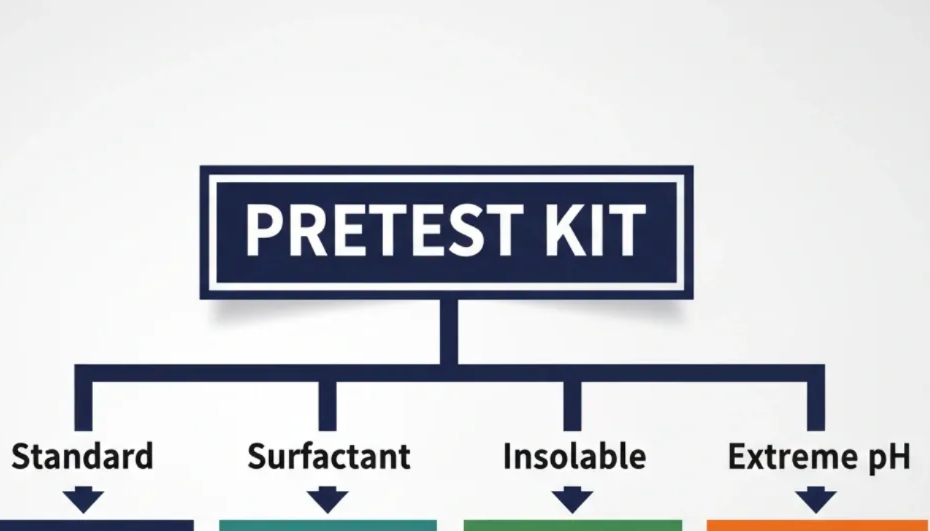 PCHP Selection
OptiSafe EIT™ Pretest Kit
SKU OSPT2903
Measures physicochemical properties (solubility, buffering capacity, foaming) to select the correct OptiSafe assay kit for your material.
One pretest kit tests 10 samples.
$600
per kit (10 test articles)
Ships within 3–5 business days
 OECD 496
OptiSafe EIT™ Main Assay
SKU OSMA2796
Nonanimal NAM to identify ocular irritants with 90% accuracy. OECD TG 496 accepted. Shelf-stable, vegan. Results in <24 hours.
One kit tests 3 samples. Additional equipment required. See kit Instructions and Lab Set-Up PDFs.
$1,800
per kit (3 test articles)
Ships within 3–5 business days
 Surfactant PCHP
OptiSafe EIT™ Surfactant Assay
SKU OSSA2489
Shelf-stable in chemico test for surfactant materials. Includes a dilution series to account for unexpected increased toxicity of some surfactants after dilution.
One kit tests 3 samples. Use when Pretest Kit indicates surfactant character.
$1,800
per kit (3 test articles)
Ships within 3–5 business days
 Extreme buffering
OptiSafe EIT™ H Kit
SKU OSHA2815
For test samples with extreme buffering values. Evaluates potential to disrupt, denature, and degrade biological molecules via extreme pH buffering.
Use when Pretest Kit indicates extreme buffering. Tests 1 test article per kit.
$600
per kit (1 test article)
Ships within 3–5 business days
 Mid-range pH buffering
OptiSafe EIT™ HMA Kit
SKU OSHM2612
OptiSafe EIT test kit for test samples with middle buffering values. Extends coverage to materials in the intermediate buffering range.
Use when Pretest Kit indicates middle buffering values. Tests 1 sample per kit.
$600
per kit (1 test article)
Ships within 3–5 business days
Free shipping on orders over $500 · Volume discounts available · Contact us
Publications
Lebrun S, Chavez S, Nguyen L, Chan R. Further optimisation of a macromolecular ocular irritation test (OptiSafe™). Cutan Ocul Toxicol. 2023;42(1):38-48.
PubMedLebrun S, Chavez S, Nguyen L, Chan R. Expansion of the application domain of a macromolecular ocular irritation test (OptiSafe™). Toxicol In Vitro. 2023;86:105515.
PubMedLebrun S et al. Ascorbic acid specifically reduces the misclassification of nonirritating reactive chemicals in the OptiSafe™ macromolecular eye irritation test. Toxicol In Vitro. 2022;80:105313.
PubMedLebrun SJ et al. Modeling the antioxidant properties of the eye reduces the false-positive rate of a nonanimal eye irritation test (OptiSafe). Toxicol In Vitro. 2021;76:105208.
PubMedLebrun S et al. Same-chemical comparison of nonanimal eye irritation test methods. Toxicol In Vitro. 2021;72:105070.
PubMedPatents
Lebrun, S., Chan, R., Chavez, S. (2024, Oct 15). Formulations and methods related to eye irritation (U.S. Patent No. 12,115,147).
Lebrun, S. (2018, Aug 7). Biochemistry based ocular toxicity assay (U.S. Patent No. 10,041,922).
Need contract testing?
LebrunLabs.co offers contract testing using OptiSafe EIT™ and other InChemico methods.