
The science behind InChemico
How non-animal safety testing works
InChemico develops shelf-stable, in chemico and in vitro kits that replace animal-based eye irritation and skin corrosion tests. Here is how the science works, why it matters, and how our products fit into the global regulatory framework.
What does "in chemico" mean?
"In chemico" refers to safety tests performed entirely using chemical reactions — no live cells, no animal tissue, no cell culture. The test material interacts with a defined biochemical substrate, and the result is measured by a change in optical density (absorbance) or color.
This contrasts with "in vitro" tests, which use living cells or reconstructed tissue models, and with "in vivo" tests, which use live animals. In chemico methods are the simplest and most reproducible of the three: they require only a spectrophotometer or plate reader, can be run at room temperature, and are shelf-stable for long-term storage.
InChemico's OptiSafe EIT™ (eye irritation) and DermaSafe SCT™ (skin corrosion) kits are both in chemico methods. They are accepted under OECD Test Guidelines and recognized by regulatory agencies worldwide for GHS hazard classification.
OptiSafe EIT™
In chemico eye irritation test — OECD TG 496
How OptiSafe EIT™ works
OptiSafe EIT™ uses a shelf-stable, vegan macromolecular test matrix that mimics the biochemical environment of the ocular surface. When a test material is added to the matrix, any ocular irritant causes measurable disruption to the macromolecular structure, detected as a change in optical density (OD) at 400 nm on a standard UV-Vis spectrophotometer.
The result is expressed as an OD ratio. The OptiSafe decision tree then assigns a GHS classification: Not Classified (NC) — meaning the material is a non-irritant — or refers the material for further testing. The method achieves 100% sensitivity for non-irritants, meaning it produces zero false negatives for safe materials.
Because the matrix is entirely synthetic and vegan, OptiSafe requires no aseptic technique, no incubator, and no cell culture equipment. A standard bench setup and a UV-Vis spectrophotometer are all that is needed beyond the kit contents. Results are available in under 24 hours.
Kit variants
Main Assay (OSMA2903)
Standard test materials — liquids, solids, and semi-solids that are water-soluble or water-miscible.
Surfactant Assay (OSSA2489)
Materials containing surfactants. Includes a built-in dilution series to capture paradoxical toxicity increase at lower concentrations.
Ci-FA Assay (OSIFA2903)
Insoluble and fatty materials that cannot be tested with the standard aqueous protocol.
Pretest Kit (OSPT2903)
Run first to determine which Main Assay variant is appropriate for your test material.

Regulatory acceptance
- OECD Test Guideline 496 — In Vitro Macromolecular Test Method for Identifying Ocular Non-Irritants
- Accepted for GHS Not Classified (NC) determination internationally
- Recognized by regulatory agencies in the EU, US, Canada, and other OECD member countries
- Suitable for cosmetics, industrial chemicals, agrochemicals, and consumer products
- Replaces the Draize rabbit eye test for non-irritant classification
DermaSafe SCT™
In chemico skin corrosion test — GHS & DOT classification
How DermaSafe SCT™ works
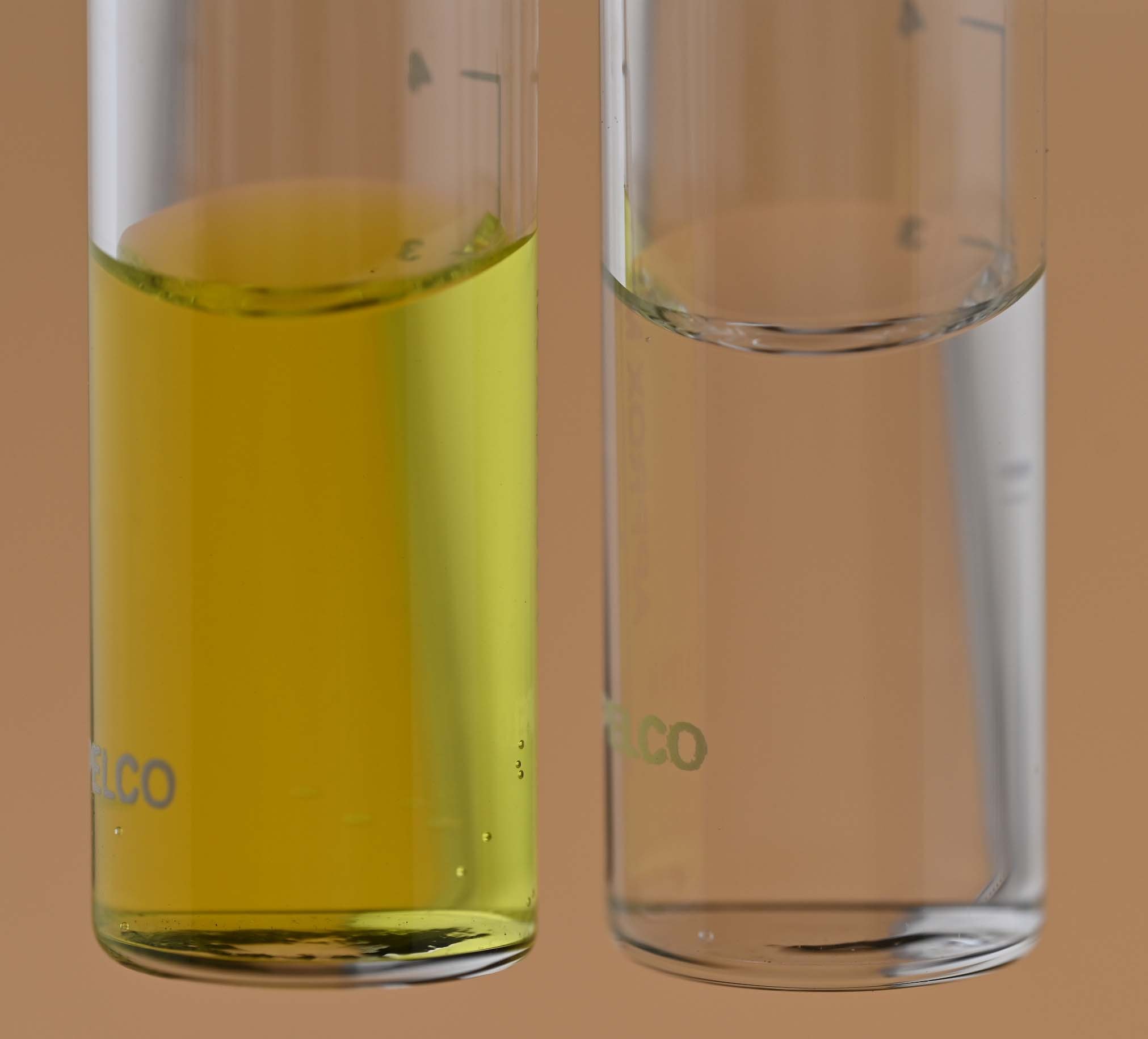
DermaSafe SCT™ uses a proprietary skin biomarker substrate that reacts with corrosive materials in a concentration- and time-dependent manner. The test material is incubated with the substrate at room temperature. A detection reagent is then added, and the resulting optical density at 405 nm is read on a standard plate reader (High-Throughput kit) or assessed visually against a color reference card (Field Test).
The DermaSafe decision tree assigns GHS skin corrosion categories: Category 1A (severe corrosive, DOT Packing Group I), Category 1B+1C (corrosive, DOT Packing Group II/III), or Not Corrosive. This makes DermaSafe SCT™ the only in chemico kit that simultaneously provides both GHS hazard classification and DOT transport packing group assignment from a single test.
No animal tissue and no cell culture are required. The High-Throughput kit tests 3 independent samples per run in a 96-well plate format. The Field Test is a portable, visual colorimetric variant designed for on-site, emergency response, and resource-limited settings.
Kit variants
High-Throughput Kit (DSHT2489)
Laboratory setting with a plate reader. Tests 3 samples per kit. Quantitative OD readout. Full GHS subcategorization (1A / 1B+1C / Not Corrosive) and DOT packing group.
Field Test (DSFT2489)
On-site or resource-limited environments. Visual colorimetric readout, no plate reader required. Classifies Corrosive or Not Corrosive with DOT packing group.
Regulatory acceptance
- GHS (Globally Harmonized System) skin corrosion categories 1A, 1B+1C, and Not Corrosive
- DOT (US Department of Transportation) packing group I, II, and III assignment
- Suitable for industrial chemicals, agrochemicals, cleaning products, and hazardous materials transport classification
- No animal tissue required — fully synthetic biochemical substrate
- Replaces animal-based skin corrosion tests for GHS and transport classification
In chemico vs. in vitro vs. in vivo: what is the difference?
A side-by-side look at the three main approaches to chemical safety testing.
| Attribute | In chemico (InChemico) | In vitro | In vivo (animal) |
|---|---|---|---|
| Test system | Synthetic biochemical substrate | Living cells or reconstructed tissue | Live animal |
| Equipment needed | Spectrophotometer or plate reader | Cell culture lab, incubator, aseptic technique | Animal facility, veterinary oversight |
| Shelf stability | Shelf-stable, room temperature storage | Requires live cells or fresh tissue | N/A |
| Time to result | Under 24 hours (EIT); under 6 hours (SCT) | 1–3 days typically | Days to weeks |
| Animal use | None | None (reconstructed human tissue models) | Required |
| Regulatory acceptance | OECD TG 496 (EIT); GHS/DOT (SCT) | OECD TG 492 (EpiOcular), TG 431 (RhE), others | Draize (eye), OECD TG 404 (skin) |
Frequently asked questions
Answers to the questions toxicologists, safety scientists, and regulatory affairs teams ask most.
Ready to replace animal testing in your lab?
Browse the full product range or contact our team for protocol support, regulatory guidance, and volume pricing.